Sujud and Safe Words

By Lola Fasina
Introduction: Scene & Authority
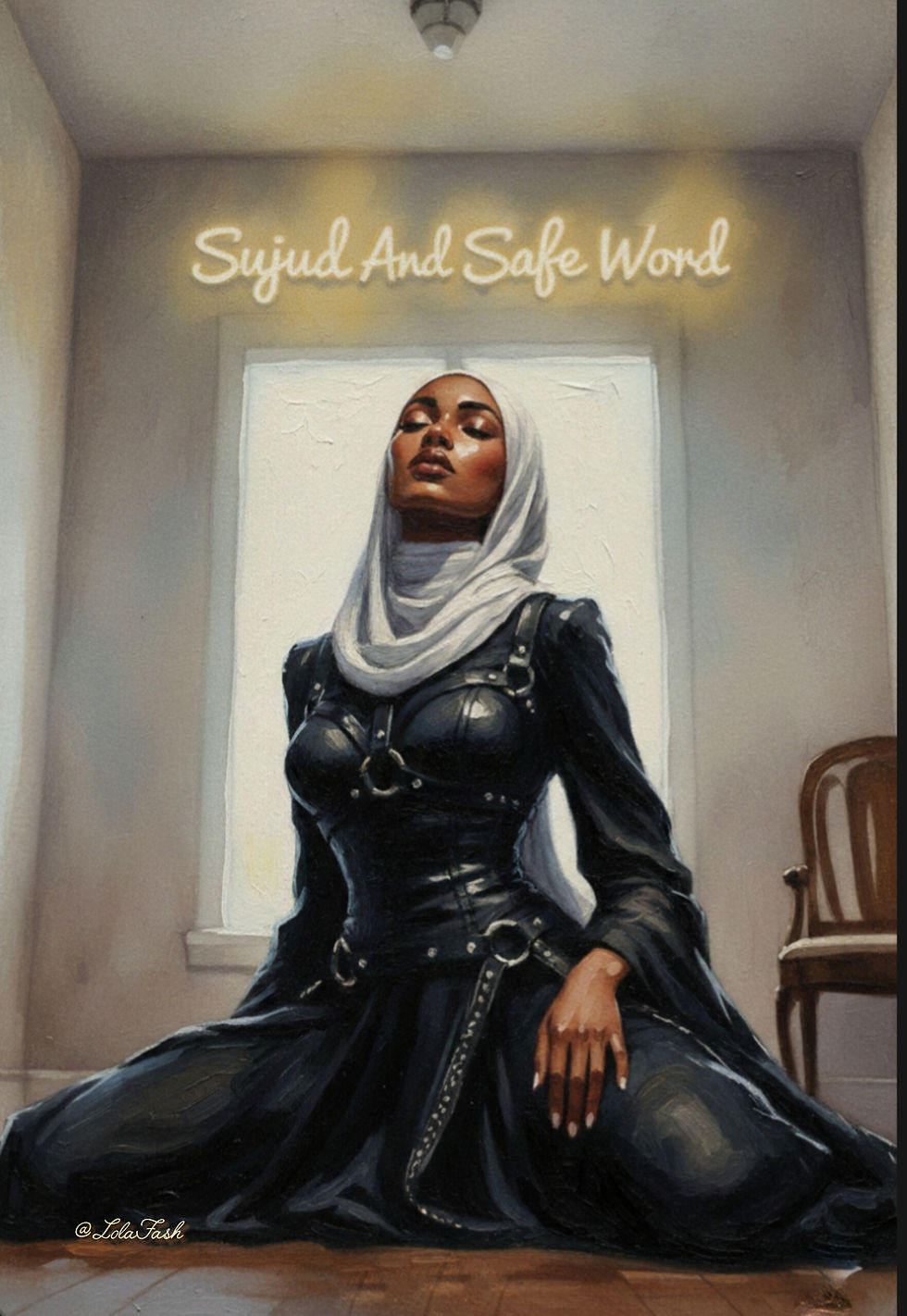
I lower my forehead to the raffia mat. My breath slows down and my spine curves deliberately. Every nerve, every joint, every inch of my skin is aware. This is what happens in sujud; because in sujud surrender is not fragility. It is discipline exercised with full knowledge of self. I choose this posture. I choose this moment. I chose this devotion, even when I was told that I had no place in it; or had lost my place in it.
I am a queer Muslim woman. I am a Domme. I wield power with clarity, negotiating boundaries ethically in kinks and fetishes, embracing desire as intelligence. All while still treating consent as moral law. I can boldly say that my body is my classroom. My mind is my curriculum. My life is my demonstration.
Community norms taught me otherwise. Modesty was said to be armor. Obedience was virtue. Silence was piety. Desire; almighty desire, was dangerous. Curiosity. As frigate as it was, it was dangerous. Pleasure was dangerous even with all the fun attached to it. Queerness was forbidden. My body became public property; my longings, a problem to manage. And yet, my body refused permission. My mind refused to quiet down. My soul refused restraint.
Lessons in Submission & Autonomy
I learned to negotiate power long before I understood it as freedom. Submission without consent is oppression. Control taken is tyranny. To dominate ethically requires reflection, responsibility, and respect. Safe words are not weakness; they are accountability made audible.
In sujud, I surrender by choice. In the playrooms, I command by choice. Both require attention, intention, and ethics. The posture alone carries no weight; the meaning lies in conscious action.
I recall the first time my body insisted on speaking its own language. I was fourteen, tracing the curve of my hands in the mirror, feeling a tension I could not name. Adulthood came early for me, it came in the shape of a bust that made even teachers vile and nasty towards me. Queerness came later but was suppressed when friends I trusted threatened and blackmailed me into silence and deep into the closet. This made me learn early that my curiosity must be silent. My gaze lowered. My body was monitored, disciplined, and policed. Desire became a threat, pleasure a liability, queerness an impossibility.
It did not work. Because I stole a kiss, and she did not flinch. She held my hand gently and guided me out of my self-locked closet.
Eventually, my queerness sharpened me. It taught me to interrogate authority. It taught me to notice hypocrisy, coercion, and performative piety. And my Domme identity? Well, that came like a fate wrapped in a gift hamper. It emerged not in rebellion, but as clarity: a method to wield power ethically, to inhabit my body fully, to command without cruelty, to assert agency.
The Sacredness of Desire
I would say that sensuality is knowledge. I found that knowledge while looking to place my aura. It was the same way I found that desire is information. My body, once treated as a site of control, became a text I could read fluently. Every pulse, every breath, every shiver teaches me about boundaries, consent, and agency.
Community norms treated desire like a leak, something dangerous to contain. Living in a society that threatens all that they don't understand or concern them, like the devil himself had taken refuge in a person. I showed up as me, for me. Yet my body was never asleep. It demanded awareness, demanded naming, demanded sovereignty. Sensuality, queer embodiment, intellectual rigor, and faith are not oppositional; they are intertwined, in me and maybe others like me.
The tension exists not in me, but in the frameworks around me. Modesty misapplied becomes surveillance. Devotion misinterpreted becomes coercion. Silence framed as virtue becomes erasure. Where my faith remains intact, the community’s comfort often fractures in the presence of women who know themselves.
Queer Muslim Domme Philosophy
I wield power deliberately. I dominate ethically. I teach autonomy through structure. Every act is conscious. Every negotiation is intentional. Every safe word is honored. I inhabit my queerness, my faith, my intellect, and my sensuality simultaneously.
People prefer binaries: good girl, bad girl, obedient, deviant. I will not fit. I kneel when I choose. I command when I choose. I speak when I choose. I long when I choose. I inhabit my body consciously, unapologetically, ethically.
Queerness does not corrupt my moral compass; it clarifies it. Desire is sacred, not scandalous. Choosing Surrender is sovereignty. Ethical dominance is a moral exercise. My faith is the scaffold for all of it, not a constraint.
Community Norms Critique
Community norms rely on compliance, neatness, and predictability. Sacredness is equated with invisibility. Virtue is conflated with erasure. Queerness is treated as a threat. Yet, the ethics embedded in consensual power dynamics often surpass the moral rigor expected of ordinary life.
I critique not the faith itself, but the interpretations and anxieties around female, queer, and sensual bodies. My faith is layered, intellectually robust, mystical, and capable of embodiment. What is fragile is the community’s comfort with women fully inhabiting themselves.
My Concluding Sovereignty
When I kneel, rise, command; I do all with my full chest. I observe. I teach. I desire. I think.
I inhabit my faith fully. My queerness fully. My intellect fully. My sensuality fully.
I am not a contradiction. I am a full presence. A student of surrender. A teacher of agency. A lady whose body, mind, and desire are sacred instruments.
Sujud and safe words teach the same truth: surrender is meaningful only when chosen. Power is ethical only when acknowledged. Desire is sacred only when embraced consciously. I have learned this. I live this. I teach this.
I am a queer Muslim Domme. I am intentional. I am ethical. I am luminous. I am sovereign. And I will not apologize for any of it.
Lola Fasina (she/they) is a queer Muslim writer, Domme, and cultural commentator whose work explores the intersections of faith, desire, and autonomy. Her writing blends memoir, intellectual reflection, and sensuality, interrogating societal norms while celebrating queer embodiment and ethical power. Through her essays, fiction, and visual storytelling, she navigates the tension between devotion and dominance, agency and submission, creating work that is unapologetically sovereign and vividly alive. Follow Lola on Instagram: @myzteriouz_ng