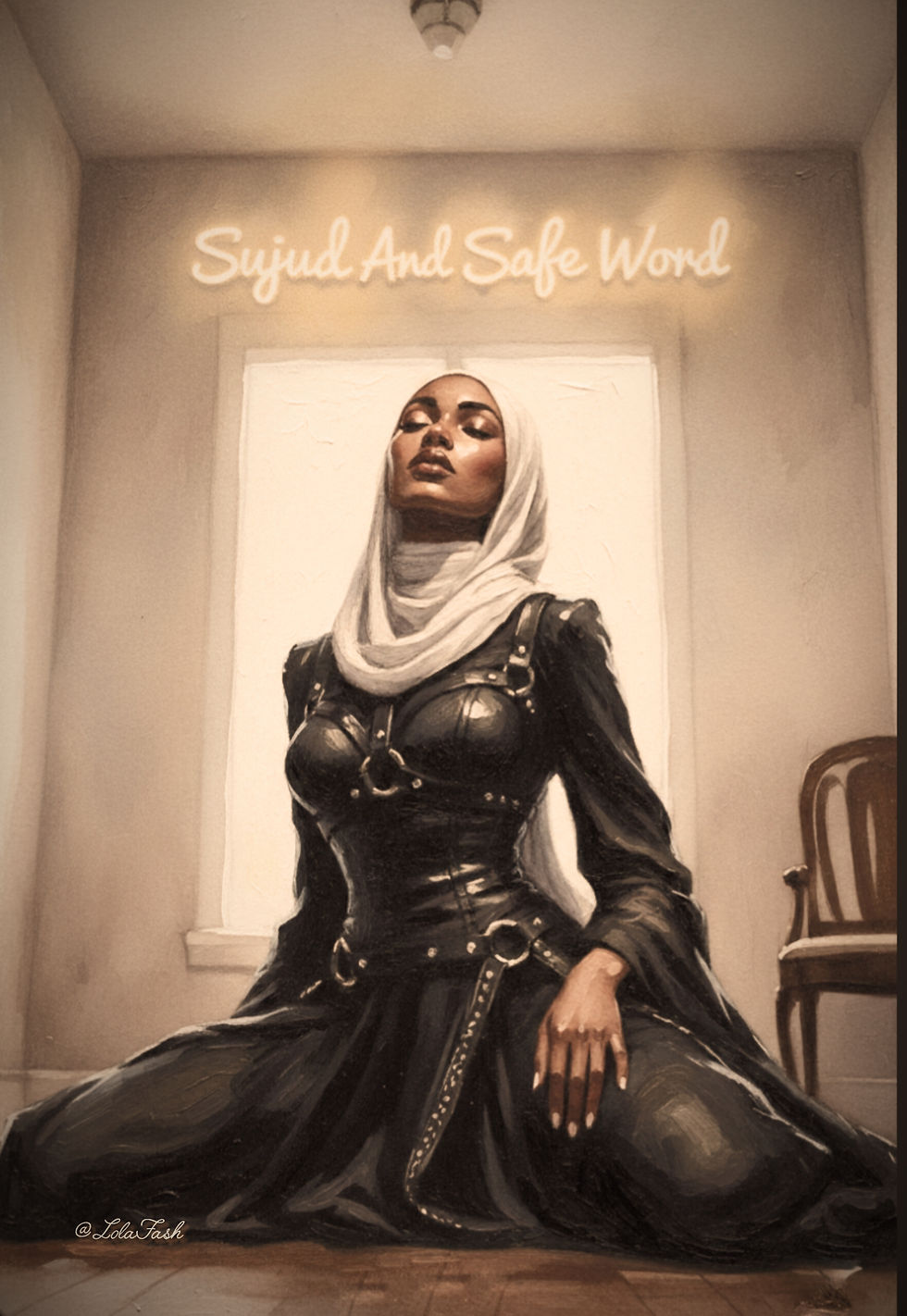
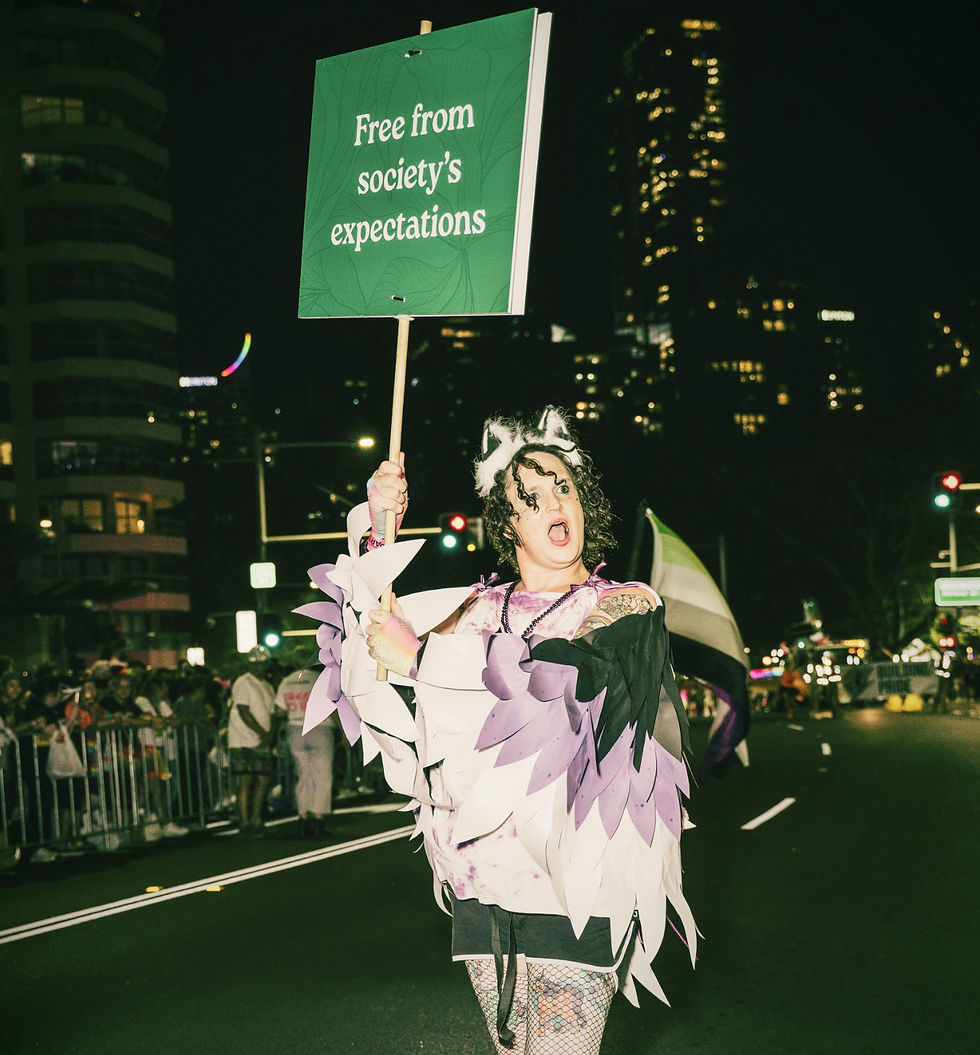
I Believe in a Utopia of Questions: On the Problem of Queer-Normative

Updated: Apr 30
By Selina Shaw

I’m going to be a bad writer and open with a stone-cold take. The worst thing about being an author is marketing your work, and the worst thing about that is the trope map. If you’re mercifully off bookstagram/booktok, a trope map is a book labelled with all the popular genre tropes it plays into, like 'enemies to lovers' in romance or 'final girl' in horror. It helps readers find their flavour. When authors make trope maps, we take something full of our personal meanings and frame it as a completed Lego set built out of pre-requisite blocks. It is in some ways akin to plastination; art is supposed to be living tissue, something that grows and evolves as it contacts its ever-changing environment, but we turn it into a fixed model of our natural expression to be coolly examined for its standardised component parts. Readers want to know what mechanically makes a piece of art, just like society increasingly asks what mechanically makes a human life. We communicate ourselves in trope maps – 'Queer, Neurospicy, Survivor, Mom' – as if those things mean something universal, as if any one word could codify the depths and diversions (and perversions) of an experience that forges a – your, my – human identity. I appreciate it’s nice to find each other and what we enjoy, but increasingly in indie arts, I feel under pressure to commodify rather than express my experience. I feel it most when I come across a favourite trope on the LGBTQ+ author map: Queer-Normative World.
Queer-Normative World means a speculative world without queerphobia and with common queer presence. It generally translates to every major character being gender non-conforming or in a non-het pairing. I don’t have any criticism for portraying a world without real-life oppression, so that Queer readers seeking escape aren’t out of the frying pan, into the fire. But it tastes wrong to me switching 'no queerphobia' for 'Queer-normative'. One promises that we won’t have to relive violence, but the other promises something much more alluring and transfiguring: read this book and you get to be normal.
It’s a strange promise to pop up on my phone screen, like a pixie hopping out of a hollow tree. Normal? You mean it? What’s the catch, my first-born? I’ve been allowed, accepted, occasionally understood, but normal? What would that even feel like? The writer tells me that I can, in these pages, watch myself move through the world as its common sense. They offer me this as a sales pitch, as if it’s a bitesize idea and not a baffling Pandora’s box of meaning. It’s supposed to conjure an instantly recognisable and appealing image, like a high-resolution photo of chocolate cake on a supermarket poster. Queer-normative is more than marketing, but when used to sell, like all marketing, it finds a pressure point and teases it. Don’t you hate feeling like you don’t fit in? Don’t you hate being at risk and under the law? Don’t you hate being endlessly discussed in public like an extraterrestrial phenomenon? Buy this book, make it all go away.
But after a lifetime of tentatively, tragically, delightedly sketching myself into existence as I am routinely rubbed out, do I now find peace in another erasure? There is radical imagining in creating worlds in which there’s no judgement of gender and sexuality. These speculations starkly illuminate the absurdity of heteronormativity so we can think and act beyond it. That is extremely useful. But Queer-normative doesn’t feel to me like a utopia of sexual and gender liberation, it feels like a retreat into the cosy comfort of an LGBTQ+ café. I don’t feel this term asks, 'What if it was normal to be Queer?' I feel like it asks, 'What if we got to be in our safe space all the time?' And that’s a lovely what if, our venues and gatherings are holy and generous, I’m not knocking them by any means. But they are also shaped by what lies outside of them. We create Queer community precisely because we are non-normative. Everything tender and transformative about the place where my identity is welcome happens in contrast to my daily strangeness. They aren’t a good example of what it’s like being the dominant culture.
I don’t mean by this that Queer identity can only be claimed through oppression. I firmly believe that self-love is more informative than self-loathing, and that it’s unkind and illogical to exclude people for being insufficiently traumatised. But unveiling our joy means sifting through the silt and shale of a heteronormative (patriarchal, colonial) world, whatever that has meant for us. That sift is everything. That sift is who I am. It’s why saying 'Bisexual, ADHD, Woman, Vaginismus' means nothing to me, because I’m not just a compilation of conditions. I’m the journey through, around, between them and the crisscrossing dialogues they and countless unlabelled truths have with every accident of being. I am a conversation between my inner and outer worlds, one that often goes off book. Admittedly, I’m white, I’m thin, I’m educated, I’m sometimes straight-passing. I have plenty of privileges in palatability. But how the inner contortions of me touch the patterns of normal is something else to holding privilege in others’ perceiving. I don't understand the interiority of normal. I've never experienced the psychological state of normal. Offer me normal, and I feel like you’re asking me to wilt away the flowers that I have nourished around my centre over long, private years.
Queer-normative for me isn't a dream come true, it’s a severance from my Queer experience. Queer is the weird, the outside, the funhouse mirror, the provocateur. The minute it's normative, it isn't Queer. It ceases to form us as we are in our world. And because I will only ever live in this world, I will only ever be abnormal in my lifetime, I can't find comfort in a character who knows nothing of what I've been through, plunged into, and clambered out of with that sketching-myself graphite in the cracks of my palms. Everything I've built, every way I've grown, every person I've loved, every feeling I've had, every boundary I've set, every deity I've worshipped has been through the lens, through the ingrained reality, of being abnormal. Sure, it would be lovely to feel the same sense of belonging everywhere that I feel at Pride. But I don't think we would experience that profound and intense belonging without our exclusion. A healed heart works very differently to one which was never wounded. I don't need to see Queer suffering, but my Queer belonging and joy is carved within that context. To be Queer is to have cosy corners, but not to live a cosy life. I’m not grateful to oppression for making us stronger, but I love myself and my community fiercely for how we flourish beyond it. I miss that flourishing when I’m around straight people, there’s a disconnect there that illuminates how I have rewilded and let myself be pruned. I can’t imagine meeting any of my Queer friends as normal, with the sparkle gone from their eyes, the scars wiped from their skin, their brilliant minds no longer flaring in critical opposition to every construct before them.
Abnormality is valuable. It isn’t always pleasant to inhabit, but it carries unmatched power and purpose. Abnormal means we have had to de-and-re-construct, we have had to explore, interrogate, go into the labyrinth. Normativity is comfortable, but it means sleepwalking. If your life runs efficiently on rails, then what motivates you to take control of living it? To quote Paradise Lost, 'Better to reign in Hell, than serve in Heav'n'. Abnormal might cast us into the pit, but it also acquaints us with the fire. Queer is Pandemonium, Queer is the serpent, Queer offers and eats the apple. Queer, Abnormal, is the clamorous seizing of free will, self-creation, and mystery. Maybe that disconnect I feel so often in straight society is the jarring realisation that I’m talking to people who have never reached out for that liberation. They’re not less deep or less human or less compassionate or less profound, but there is a specific lack in their experience. In the way they pity what of theirs I’ll never have, I wish for them the divine ecstasy of a fall from grace. Must be nice, I guess, to never have been rejected by the angels, but the feeling of fiendish fire between my hands is worth more to me than all the ease in the world.
That fire is more than our individual path. Hell is powerful and exciting because it is not contained. It impacts humanity, it rends and radicalises the earth. Queer, like Satan, is an intervention in order. That’s why we’re marginalised at all, because we threaten the status quo. Maybe we never asked for that, maybe it’s a burden, but I can’t stop feeling blessed. I love that me, my lover, and my friends are dangerous. I love that we are challenging. I love kissing my partner and knowing that the electric charge between our lips makes a lightning bolt that strikes the palace spires. I want always to kiss like a small god. Queer-normative might mean looking at cosy Queers, but it also means looking at the people I know flattened, made mortal. They lose their wisdom, their ferocity, their iron spines, their trickery, they see so much less of reality, they are defanged. I love us, I love us so much, for our intuition and our teeth, and we grew those things in the margins. As much as straight people like to ogle us, our otherness makes us keen observers. It’s often said that great art is made in the margins. That’s because the people who best understand the system are the people for whom it doesn’t work.
To be Queer is to be an alchemist. We are in the seams of the surface world, unpicking it and playing with its arcane truths, making and discovering. We are cauldrons of ideas and sparks of resistance. If we become normative, we lose our ability to create new possibilities, to bring about change. Yes, I want a good world, and yes, I want us to imagine that. But I don’t want a finished world. I want, everywhere I live, to be challenging and expansive, to embrace growth and the unknown. There are things we do because we have reason or desire, and there are things we do because they are done. Queer-normative makes Queer what is done, and even when done things are healthy, I never want to do anything just because it is the way. I never want to not know why I’m living like this. I never want to love by rote or look at my body unconsciously. Queer saved me, not because it gave me a new place to tuck into, but because it gave me the impetus to live on purpose, at the culmination of challenge and response and progression. I have spent too much of my life following someone else’s sense-making, being whatever is easiest; I don’t fantasise about it now. I want us to celebrate ourselves as agents of change, as mystics, witnesses to the incomplete, unhealed world. Activists often say that their goal is to make themselves obsolete, but I never want us satisfied. I want us always finding the next perhaps.
The promise of normal robs us of our relationship with transforming self and society. But I also worry it robs us of each other’s wholeness. Queer-Normative is used with a utopian undertone – there will be no exclusion, because We The Queers don’t set norms. But a hard thing we have to get better at admitting is that we, like all products of society, do gravitate to rule-making. We make norms around race; the white supremacy in alt fashion and gender bending, the cultural norms of what even counts as Queer. We make norms around lifestyle; the dominance of urban experience, the online trends, iced coffees and Britney hits and 90s cartoon crushes. We make norms around presentation: butch, femme, leather, single earrings, the non-binary Hawaiian shirt. We make norms around monogamy; the prioritisation of marriage rights, the discourse around polyamory. We make norms around sex: no kink at Pride, two short fingernails, the pressures on Ace people. We make norms around gender: the parameters of trans, what androgyny encloses. We make norms around coming out: how, when, who to, that it happens once and changes your life. We make norms around language: top, dyke, stone butch, pillow princess, bear, otter. In the end, we are a community, and communities are formed around what people share. There’s great beauty in the cultures we and our ancestors built, our secret codes, our family traditions. But we can’t have those things without integrating them into our community as norms, and with that process comes bounding, much of it exclusionary. We are not inherently less prone to making up rules and patterns or judging each other for not conforming.
As a rural bisexual person, I’m regularly reminded of the Queer community’s norms and the ways I don’t fit, the trajectories I don’t fulfil, the ways in which I disappoint. In Queer-normative worlds, I continue to be discomfiting, because I force heterosexuality into the equation. My sexuality is Queer, but a lot about my sexuality isn’t Queer. I like boys and being a girl who likes boys. I like talking to other girls who like boys about boys. There’s a lot that I take genuine pleasure in that is very, very straight, problematic even. And, to now also alienate the bi readers, I have sympathy for the Queer folk who don’t feel safe around that. If heterosexuality has abused you, and you came to this community to feel safe from it, I actually think it’s fair for you to not want anything to do with my basic bitch baggage. But in accepting that, I make a concession to the community’s norms and comfort over my authenticity, just like I do with my straight friends; and if there’s one norm for being bisexual, it’s the weary work of code-switching. As a Queer Abnormal, the tag Queer-Normative World doesn’t promise me automatic inclusion. I look at it with the heavy exhaustion of wondering how much of myself will be problematic this time. Who am I harming in this setting just by feeling privately in my bedroom?
Neither are we inherently untethered from abiding by mainstream structures. Queer-normative writers are not immune to maintaining other dominances in their work, even though in a world where there truly had never been queerphobia, there should not have been patriarchy or white supremacy either, so interlinked are these constructs. Imagination is always productive, but we need to confront limits on our speculations of a transformed world if we’re going to use it to craft a vision of ultimate liberation. I worry the term Queer-normative discourages us from that confrontation, because it’s presented as an automatic complete success, no past wrongs and nowhere to go.
Like Queer Community, a Queer-Normative World is a space where we go to express the parts of our identity that are unwelcome in the current mainstream. It’s an invitation to rest, to release the labour of being different, to allow an animal body a moment in its skin and skeleton, rather than the breathless corset of its political implications. We need that, we deserve that. Go to your cafés and your craft corners, write your speculative books. I’ll see you there, I also value it. But I want us to go into these spaces being able to trust in our welcome, not our conformity. I want us to consciously acknowledge that a sanctuary from heteronormativity is not the same as a binary reversal with new and better norms. Liberation is not a coin flip to the single other, superior way of being. Normativity – any normativity – means diminishment. It means that we live more mechanically, more governed, and so it means that we live less consciously, less intuitively, less boldly, less creatively, as less than who we have it in our wild hearts to be. We deserve rest, but we also deserve better than sleepwalking. The normative world is adept at packaging Queerness up into a set of tropes that fool us into thinking we’re seeing ourselves reflected. What we’re looking at is their clean photo-edit of our possibilities, and we must guard against that sleeping drug. We so want to be normal – we’re people, it’s natural – but we cannot give up our Pandemonium, and we cannot give up on those in our family who threaten the dream that one day we’ll fit in. We deserve rest, but we build energy there to come back out into the normative and break it, defiantly, jubilantly, devilishly.
Queer is not a place, it’s a verb. Queer means question. Queer is not about longing to be comfortable. We are beautiful and essential because we are living abnormalities, living challenges, divine and death-defying mutations in an otherwise mortal body. Even in a world in which everyone can publicly hold hands, we will still need to queer it. Even in our utopia, we will need the abnormal, the alternative, the non-conforming. Liberation isn't a stale perfection, a linear completion, or a predictable outcome. Liberation is the embrace of eternal flux and evolution, a society beyond norms where we are constantly allowing ourselves to absorb, resist, reform, and instantly problematise again. I don't believe in an end point at which everything has an answer. I believe in a utopia of questions. My favourite thing about being Queer is getting to live in my own way in a utopia of questions. I love my folk and I want us to be happy, but I hate the idea that one day that could mean being answered, finished, cosy, thinking and feeling and imagining just like everybody else.
Bio: Selina Shaw (she/her) is an English love witch and writer of queer femme romance and horror. She believes storytelling is a crucial site of resistance and enjoys writing that uses folklore, the gothic, the erotic, and the unresolved to explore rewilding the self.
Follow Selina on Instagram @shawberrytart
Photo credit: Betty B